This vaccine season, the biggest challenge facing pharmacies isn't getting patients through the door. It’s what happens once they're already there.
Cold and flu season is right around the corner, and pharmacies across the country are gearing up for the busiest time of year.
That means increasing staff, opening appointment schedules, and calculating inventory to meet the needs of the nearly half of Americans expected to get a vaccine this year. For many, preparation brings logistical hurdles, operational obstacles, and more than enough stress to go around.
But according to Rannon Ching, independent pharmacist and Co-Founder and CEO of AccessPoint Vaccine Partners, the source of that stress isn’t demand. It’s capacity.
With so many patients seeking vaccines, says Rannon, operational capacity can quickly become stretched. From intake to eligibility to increasingly tedious workflows that break down under seasonal demand, it can be difficult to keep up.
When those seemingly small bottlenecks add up, pharmacies often find themselves unable to provide services they're already equipped to offer.
That means turning away patients, missing opportunities to improve community health, and leaving tens—or even hundreds—of thousands of dollars in potential revenue on the table.
The challenge for pharmacies this vaccine season, then, is not creating demand. It's creating the capacity to meet it.
The RedSail Media team sat down with Rannon to figure out how:
Vaccines are an important service for many pharmacies, but for Rannon, they’re much more than that.
From his early days in pharmacy school to his decade-long career at Tarrytown Pharmacy to his new venture at AccessPoint Vaccine Partners, a free to join vaccine-only GPO which helps independent pharmacies across the US grow their vaccine services, Rannon has spent much of his career focused on vaccinations.
“I've always been passionate about vaccines, even since I was a pharmacy student,” says Rannon. “COVID was huge for learning the process of how to scale, and I think everyone got really well accustomed to it. It's something I've been super passionate about [ever since].”
He imagines vaccines as existing in a Venn diagram.
If, on one side, is patient care, and on the other is profitability, “vaccines are right there in the middle,” says Rannon. They’re equally about “doing the right thing for the patient” and “[becoming] a driver of your business as well.”
Profitability isn’t something pharmacies can afford to overlook.
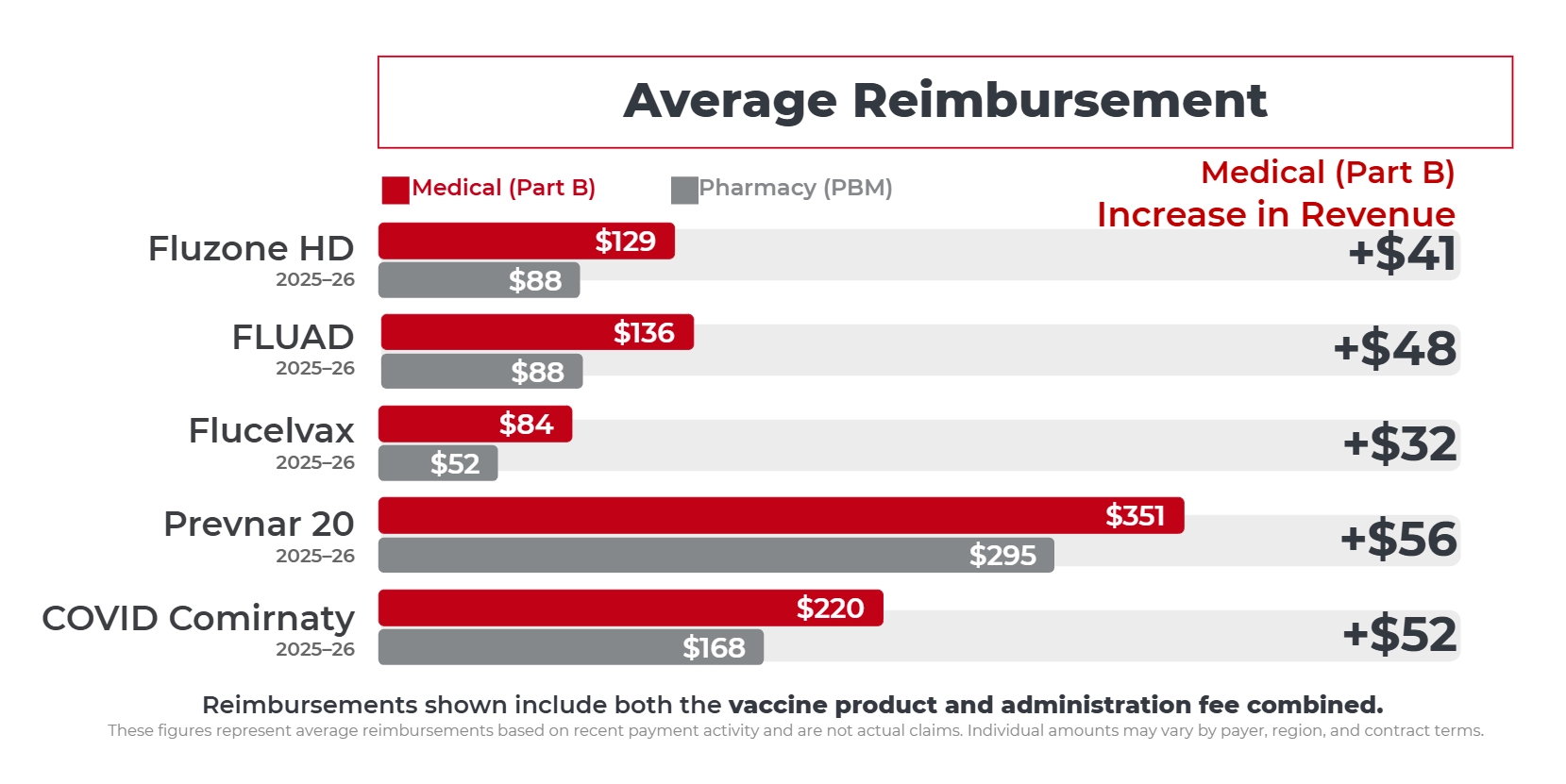
As pharmacy reimbursement continues to face pressure, vaccines can offset low margins. Unlike traditional pharmacy claims, vaccines can often be billed as a medical service and reimbursed at a higher rate.
Compare the rates:
For Rannon, then, the question isn't whether pharmacies should invest in immunizations. It's whether they're thinking big enough.
“How can you take the immunization segment of your business, which might be doing 100 or 200 flu shots, and get that to 10,000?” he asks.
The answer starts with knowing what prevents vaccine programs from scaling in the first place.
For many pharmacies, scale isn’t limited by demand but by capacity. And when capacity falls short, it’s patients that pay the price.
“My philosophy has always been that I never want to turn away a patient who’s willing to get a service from you because you don’t have the capacity,” says Rannon.
Capacity, in this context, doesn’t refer to clinical capability. Most pharmacies already have the expertise, staff, and inventory needed to administer more vaccines, after all. Instead, it refers to operational readiness: that is, the workflows that support everything before and after the vaccine itself.
In Rannon's experience, vaccine operations tend to break down in a few key areas:
For Rannon, solving these problems isn't about working harder. It's about removing friction.
“How can we become more efficient?” he asks. “How can we get bandwidth back so that [when] anyone who comes in [to get a vaccine], [the process] is so frictionless, so easy — it works in your normal workflow — and [we] can capture that?”
Luckily, says Rannon, capacity can be built.
“Sometimes people just need to be shown the process and walked through it,” he says. “I have so much fun talking to people about their processes and how we can improve them.”
As vaccine volume grows, pharmacies need processes that can scale alongside it.
Rannon recommends examining each step of the vaccine workflow and identifying areas for improvement: Where are you slowing down? Where are you getting stuck? What recurring tasks are cutting down on your time?
When you identify pain points, you can begin implementing processes that remove friction from the workflow. With these processes in place, you might just find that workflow can not only maintain but actually create capacity.
Here are a few ways Rannon recommends preparing your workflow for vaccine season:
Manual work—from patient intake to data entry—is a time-suck for any vaccine program.
That’s why Rannon recommends using technology, like your RedSail pharmacy management system, to accelerate (and sometimes even automate) routine tasks.
Rannon, a long-time PioneerRx user, uses a few different features to standardize this process:
By reducing repetitive tasks, pharmacy teams can spend more time on the clinical side of vaccines.
Rannon also recommends separating vaccine workflows from prescription workflows whenever possible.
When vaccine appointments and prescription processing live in the same queue, they can compete for attention. Lines get blurred, bottlenecks pop up, and time gets sucked down the drain.
Creating dedicated vaccine workflows can solve these issues.
“I think that's a helpful way to keep things organized, and it gives you the freedom to keep things a little more structured,” Rannon says.
One of the biggest barriers to scaling vaccine programs, according to Rannon, is medical billing.
As pharmacies expand their immunization services, they take on more administrative responsibilities. Vaccine claims often require eligibility verification, clinical documentation, CPT coding, reimbursement tracking, and claim follow-up.
Each of those tasks takes time.
And every minute spent verifying coverage, correcting claim errors, following up on reimbursement, or managing documentation is time that can't be spent serving patients.
To run a successful vaccination program, Rannon says, pharmacies have to balance two goals: meeting the administrative requirements of medical billing and maintaining the fast, convenient experience patients expect from their pharmacy.
RedSail Medical Billing can help reduce that burden by:
RedSail Medical Billing also helps pharmacies reach a near-100% reimbursement rate for vaccination claims. That way, pharmacies can not only administer vaccines more efficiently but also make sure that they get paid for it.
To learn more about RedSail Medical Billing and how it can help add to your capacity, click here.
Technology can help create efficiency, but Rannon believes some of the best lessons come from other pharmacies.
“One of the biggest things I've found... is that almost everyone's story has that mentor figure who invited them along and showed them the ropes,” Rannon says.
Whether those lessons come through peer groups, webinars, industry events, or manufacturer education programs, learning from pharmacists who have already solved similar challenges can help you avoid common mistakes and kickstart your growth.
"I think there's so much value in collaborating with other pharmacies and sharing information," he says.
As vaccine season slowly creeps up, it's easy to focus on what happens at the counter.
But as Rannon Ching shows us, capacity is built long before a patient ever rolls up a sleeve. For Rannon, that means building the right workflows, implementing the right processes, and using the right technologies to start—and finish—vaccine season off strong.
Whether you're administering 100 vaccines or aiming for 10,000, success this season won't come down to luck. It'll come down to preparation.
Every streamlined workflow, every automated task, every eligibility check completed ahead of time, and every claim submitted correctly creates a little more capacity for your pharmacy to serve another patient.
After all, every vaccine offers an opportunity to protect a patient, strengthen the state of public health, and diversify your revenue.
The patients are ready. Now it’s time to make sure your pharmacy is, too.